

Egypt Unfiltered: What Happens When 12 Gay Men Sail the Nile
09/15/2026
It was somewhere between the second glass of Egyptian wine and the moment one of our crew members grabbed my hand to teach me a traditional dance that I thought — nobody is going to believe this.
We were anchored on the Nile. The stars were out. We were all wearing galabayas — traditional Egyptian robes our Egyptologist had recommended we pick up at a local shop earlier that day — and a local band was playing just for us on the riverbank. The crew, who I don’t think usually does this, stepped off the boat one by one and joined us. Smiling. Dancing. Teaching us moves none of us would ever replicate correctly but all of us tried anyway.
That moment wasn’t on the itinerary. It happened because we were twelve guys on a private boat, with a crew that had decided they liked us.
That’s Egypt. That’s Pivot Trip. And that’s why I’m running this trip again.
The group
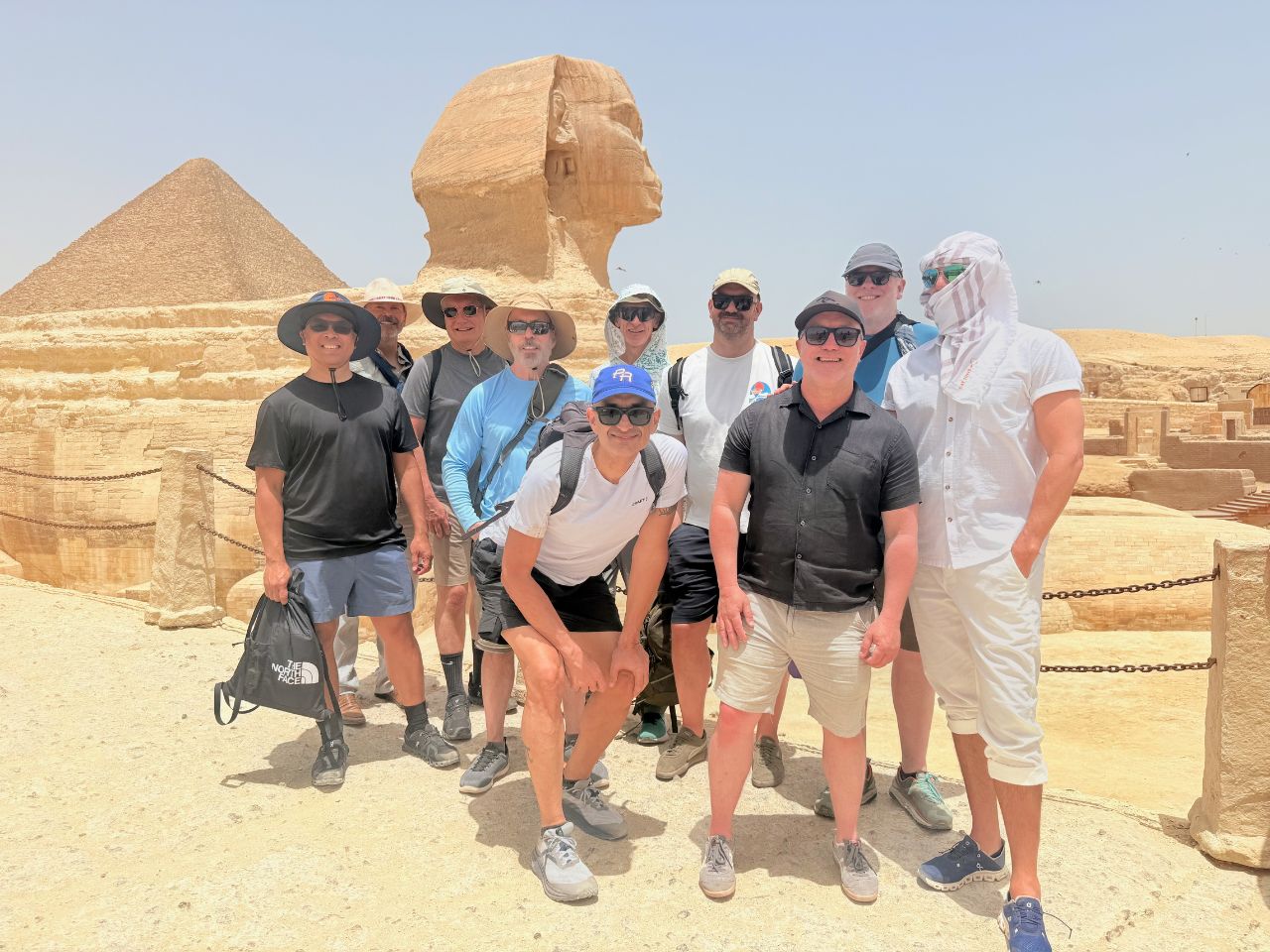
Twelve guys in their forties, fifties, and sixties. Half had traveled with me before — some on multiple trips. The other half were first-timers, a few of them solo travelers, a couple of pairs. By the welcome dinner on the Nile the first night, you couldn’t tell the difference. Egypt has a way of doing that to people. You arrive as strangers and within 48 hours you’re sharing one of the most surreal experiences of your life together.
The pyramids
There’s no way to prepare for standing in front of them.
You’ve seen the photos your entire life. You think you know what to expect. And then you’re there — and they’re massive in a way that photographs simply don’t communicate — and you realize you had no idea.
We went inside the Great Pyramid of Khufu. We stood at the Sphinx close enough to study every detail of it. We had lunch on a terrace overlooking all of Giza, the entire complex spread out below us. Our Egyptologist was with us the entire time — giving us the context we needed at each moment, enough history to make everything land, without turning it into a lecture. You had time to stop. To look. To take photos. To just stand there and feel the weight of where you were.
Some moments you don’t take photos of. You just decide to be present for them. This was one of those.
The boat
This is where Egypt becomes something else entirely.
Most Nile cruises put you on a boat with a hundred, sometimes a hundred and fifty other guests. Those boats can only dock at the larger, busier stops along the river. You move with the crowd. You see what everyone sees.
We chartered a private traditional Egyptian sailing vessel with eight cabins, staffed by a crew that outnumbered our group. Just us. And because of that, everything was different.
We docked in quiet places along the river that the larger boats never reach. We swam in the Nile — the crew made sure we were in a clean, safe stretch of water — and they set out towels on the riverbank like it was the most natural thing in the world. We had a candlelit dinner on the shore of the Nile one evening, just our table, just our group, lights strung across the bank and the boat glowing behind us in the darkness, stars overhead. It was something out of a film. Except it was real and we were in it.
One afternoon, floating south, we all gathered at the back of the boat — there’s a shaded lounge that sits just above the waterline, breeze coming off the water, the banks of the Nile drifting slowly past. Our Egyptologist sat with us for a couple of hours and walked us through the entire arc of Egyptian history. Chronologically. From before the pyramids all the way to present day. Five thousand years, pieced together in a way that made everything we’d already seen — and everything we were about to see — suddenly connect.
It was the kind of history lesson that only works because of the setting. Floating down the same river that all of it happened along. Questions welcome. No rushing. Just the group, the water, and someone who had spent their entire life learning this and was genuinely excited to share it.
The temples
Because we were a private group moving outside the main tourist windows, we often had these places almost entirely to ourselves.
The Temple of Edfu. Kom Ombo. The quarry at Gebel el Silsila, where you can walk through the stone and understand exactly where the blocks came from that built everything you’d been looking at. The Temple of Esna. Karnak. The Valley of the Kings, where we visited the tombs of Ramesses V and VI, Tutankhamun, and Seti I.
At each stop, our Egyptologist gave us what we needed — the big facts, the meaning behind what we were seeing, the stories that made the hieroglyphs on the walls come alive. And then we had time. Time to wander. Time to photograph. Time to just absorb it.
Standing inside these spaces with eleven other people — no crowds, no tour groups pushing past — changes the experience completely. You can stop. You can look. You can feel the weight of where you are.
A note on safety
Egypt raises questions for gay travelers, and they’re fair ones. Several guys on this trip — including couples sharing rooms — asked before we left whether the crew and staff would be comfortable with our group.
The answer, without qualification, was yes.
The crew was professional, warm, and attentive in a way that had nothing to do with the composition of our group. They treated us exceptionally well from the first day to the last. Nobody on this trip — not in Cairo, not on the boat, not at any temple or monument — felt unsafe or unwelcome at any point.
This is largely because of how the trip is structured. World-class accommodations. A private vessel. A dedicated Egyptologist who managed our access and movement throughout. When you travel this way, with a small private group and people who know the country deeply, the experience is fundamentally different from navigating it on your own.
The last morning
Before we docked for the final time, I sat in the little lounge at the stern of the boat. The water was moving past slowly. The banks were quiet. I thought back through the whole trip — the pyramids, the dancing, the dinner on the shore, the history lesson on the water, the temples we’d had almost entirely to ourselves — and I thought: we have to do this again.
Egypt is a bucket list destination for a reason. But the version of Egypt we experienced — private, intimate, unhurried, with a group of gay men who were genuinely there for it — is something most people never get.
I want more guys to have this.
Egypt 2027 is ready to go — ten days, twelve guys, one private boat.